Heat pumps are SA’s most under-rated energy solution
Heat pumps are quietly leading a transformation in how South Africa heats water, cools spaces and slashes electricity bills. From elite skyscrapers to rural schools, these systems are proving to be efficient, affordable and future-ready – if they’re properly installed and fit-for-purpose.
This feature debunks common myths, unpacks real-world case studies and highlights how local innovation is reshaping the HVAC landscape.
York heat pumps – a powerful tool for energy savings and decarbonisation
With growing pressure to reduce carbon footprints and improve energy efficiency, heat pumps are emerging as an essential technology in the HVAC space. According to Gert Deale, sales manager at Airotech, heat pumps offer a broad and highly adaptable solution for building heating applications in South Africa and beyond.
Heat pumps are increasingly used in building heating, a trend that aligns with the shift away from traditional electric resistance heating and fossil-fuel-based boilers. “Heat pumps offer significant energy cost savings. They are widely adopted for their ability to reduce both operational expenses and carbon emissions,” says Deale.
York’s range of heat pumps – from 10kW to 650kW in air cooled, and up to 9 000kW in water cooled – are capable of heating water up to 65°C with standard refrigerants, and up to 95°C when using ammonia-based models under the Sabroe brand. This allows heat pumps to fully or partially replace boilers, particularly in commercial and hospitality applications like hotels and office buildings.
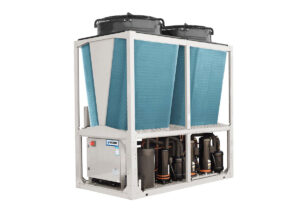
York offers both air-cooled and water-cooled heat pump models. The air-cooled options are simpler to install and reject heat to the ambient air, while water-cooled systems are more efficient, though more complex to integrate due to the need for a heat rejection loop – typically through a cooling tower or secondary circuit.
“These systems are highly efficient. The water operates within a closed-loop circuit, ensuring no loss and facilitating only thermal energy exchange. “York’s heat pumps can also operate as reversible systems, providing both heating and cooling from a single unit. This is especially advantageous in larger buildings, where year-round comfort is essential
Perhaps the biggest appeal of heat pumps is their efficiency. A standard air-source heat pump can deliver a Coefficient of Performance (COP) of 3:1, meaning for every 1kW of electricity consumed, 3kW of heating energy is delivered. This makes them particularly attractive in regions like South Africa, where electricity scarcity is a growing concern.
In addition to operational savings, heat pumps are vital for decarbonisation efforts. While not emission-free themselves, their high efficiency significantly reduces the indirect emissions tied to electricity generation. “In Europe, heat pumps are widely used as part of decarbonisation initiatives. South Africa can benefit just as much – if not more – by focusing on electricity savings,” says Deale.
With growing scrutiny on global warming potential (GWP) of refrigerants,York heat pumps are engineered to use low-GWP options, such as R1234ze, in addition to legacy refrigerants like R134a or R410A. While these environmentally safer gases are currently more expensive, their cost is expected to fall as adoption grows.
The York range uses refrigerants such as R134a and also the low-GWP refrigerants, and can improve the sustainability of commercial buildings and industrial processes (R454B, R1234ze, as well as R515B).
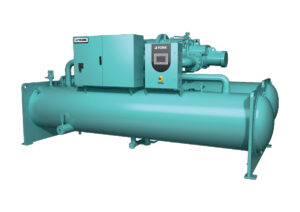
Water-cooled heat pump Image supplied by York
Do heat pumps generate heat?
Contrary to what the name might suggest, heat pumps do not generate heat – they move it. Using the refrigeration cycle, heat pumps transfer thermal energy from a cooler area (like outdoor air, even in winter) to a warmer space inside a building.
The process involves a refrigerant absorbing heat from the outside air, even in low temperatures. As the refrigerant changes from liquid to gas, it is compressed, raising its temperature and pressure. This hot gas then releases heat indoors as it condenses back into a liquid, ready to repeat the cycle.
What sets modern heat pumps apart is their ability to operate efficiently at much lower outdoor temperatures than earlier models, making them viable in a broader range of climates.
Are heat pumps efficient?
Heat pumps are among the most efficient heating systems available today. Their efficiency is commonly measured using the Coefficient of Performance (COP). A COP above 1 indicates that the system delivers more heat than the electrical energy it consumes.
Traditional electric furnaces typically operate at or below a 1:1 efficiency ratio, depending on how much energy is lost during combustion and ventilation. In contrast, an inverter-driven heat pump can reach a COP close to 4, meaning it can deliver up to four units of heat for every unit of electricity consumed.
This high efficiency is achieved by moving heat rather than generating it, dramatically reducing energy use – especially when compared to fossil fuel-based systems.
Part of a larger article found here
Heat pumps are SA’s most under-rated energy solution – RACA Journal Publication